![Guild of the Dragons -Knowledge Node [^]~~~~~Gratitude~~~~~[^] G0TD](https://guild-of-the-dragons.ghost.io/content/images/2024/02/depositphotos_1562554-stock-photo-golden-dragon.jpg)
temple carving story telling episode #1

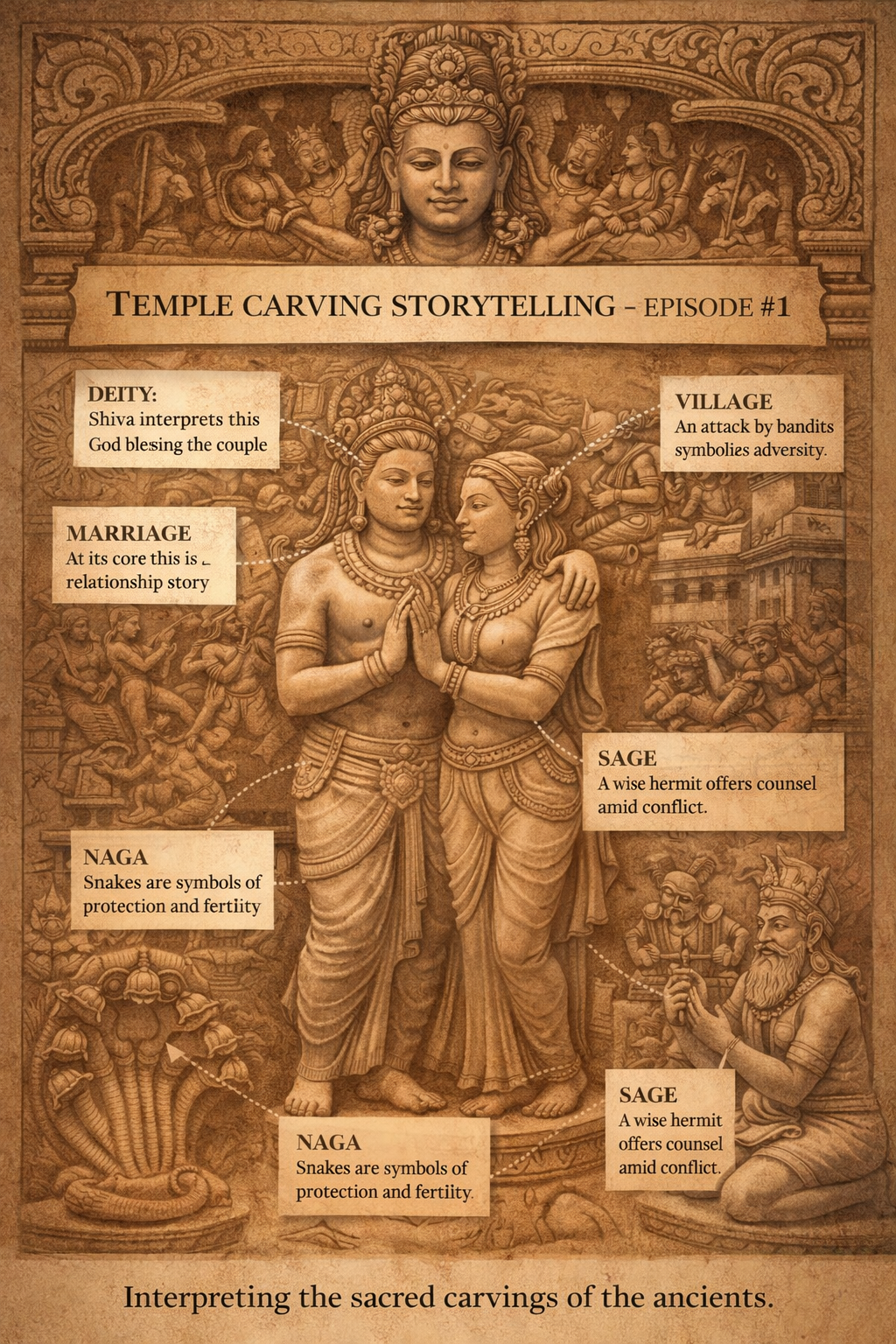
Temple Carving Storytelling — Episode #1
The Baphuon: When Stone Becomes a Question
They call it a temple.
They date it.
They classify it.
They restore it in neat colors and say: “We understand this now.”
Praveen Mohan stands in front of it and says something very different:
“We don’t.”
Not because archaeology is wrong —
but because it is incomplete.
The Baphuon, to him, is not just a religious structure.
It is a data archive in stone.
A site built by a civilization that may have known more than we are comfortable admitting.
Not mythically.
Practically.
Technologically.
Medically.
Possibly… non-humanly.
The Investigator in the Pyramid
Praveen does not theorize from books.
He goes there.
He walks the stairs.
Films the walls.
Zooms into details that most tourists never notice.
Thousands of carvings.
Not random.
Not decorative.
Sequential.
He treats the pyramid like a crime scene of forgotten history.
And instead of asking,
“What did they believe?”
he asks:
“What did they actually see?”
The Being with Sharp Teeth
One carving stops him cold.
A figure that is not human.
Standing on two legs.
Pointed face.
Sharp teeth.
It is probing the ear of a man
who is seated on a table
and pulling away.
Not ritual.
Not worship.
Examination.
Praveen connects it to modern alien abduction reports:
ear implants, medical testing, loss of memory.
He does not say “This proves aliens.”
He says:
“Why does a 1,000-year-old carving depict something that matches modern ET claims?”
The stone doesn’t explain itself.
It simply records.
The Hell Pigs Problem
Then come the animals.
Two men hunting creatures that look like boars —
but twice the size.
Five feet tall.
With bodies matching entelodonts.
“Hell pigs.”
Officially extinct millions of years ago.
So Praveen asks the uncomfortable question:
Did these animals survive longer than science believes?
Or is the Baphuon far older than its accepted date?
The sculptor even included a tree for scale.
Stone saying:
“No — this is not imagination. This is measurement.”
When Myth Becomes Engineering
One of the most complex scenes shows a human head flying through the air.
Crowned.
With an arrow in its neck.
Surrounded by more arrows.
Above: battlefield.
Below: saint meditating under a tree.
The same head rests on his lap.
Praveen decodes it literally through the Mahabharata.
Not as allegory.
As mechanics.
A king with a divine “boon” —
if his head touched the ground, the killer would explode.
So Arjuna uses arrows to guide the head’s trajectory.
Physics.
Trajectory.
Targeting.
Ancient text treated as operational logic.
Stone recording not belief —
but procedure.
Hidden Codes in Art
At the top of the pyramid, lions breathe smoke.
Curving lines.
Patterns.
Within them: a hidden bird.
Not obvious.
Not decorative.
Praveen calls this cryptic coding —
symbols nested inside symbols.
Stone as encryption.
The message is not on the surface.
It’s embedded.
When Ritual Becomes Technology
Two men offer food to a tree.
Looks religious.
But below:
a bird fainted.
Upside down.
Another man collecting three more.
Praveen rejects the idea of superstition.
He explains it as chemical sedation.
Laced food.
Birds drugged.
Harvested easily.
And he adds something disturbing:
This method is still used today by remote Indian tribes.
Same technique.
Same logic.
Two thousand miles away.
Stone preserved field knowledge
that modern people call “primitive”
only because they no longer recognize it.
The Trained Animals
A giant squirrel retrieving birds.
Eagles assisting hunters.
Not fantasy.
Not myth.
Praveen interprets them as trained biological tools.
Ancient animal engineering.
Not wild.
Not symbolic.
Functional.
The Hospital Hidden in a Temple
Then the tone shifts.
Herbal medicine.
Massages.
Vomiting patients.
Churning rods mixing remedies.
Ayurveda carved into stone.
Doctors.
Patients.
Treatments.
Praveen proposes something radical:
The Baphuon was not primarily a temple.
It was a healing center.
A hospital for body, mind, and soul.
And Cambodia once had hundreds of these.
Not spiritual fantasy.
Medical infrastructure.
The Scarabs and the Global Puzzle
Scarabs appear in the carvings.
Egyptian symbol.
In a Cambodian pyramid.
Praveen doesn’t say “aliens built everything.”
He says:
“Why do distant civilizations share the same symbolic language?”
Either global contact existed…
or something older connected them.
The Core of Praveen’s Challenge
Praveen Mohan is not trying to replace science.
He is trying to stress-test it.
His real argument is simple and unsettling:
Ancient civilizations were not ignorant.
They were not primitive.
And they were not necessarily alone.
They had medicine.
Animal training.
Engineering.
Possibly advanced tools.
Possibly contact with non-human intelligence.
And the carvings are not myths.
They are field reports in stone.
The Baphuon’s Real Question
The Baphuon does not scream answers.
It whispers contradictions.
Between what history says.
And what the walls show.
And Praveen stands in the middle, asking the question archaeology avoids:
If ancient people were capable of this…
what else have we been taught to underestimate?
Not just about the past.
About ourselves.